Heyawake
Heyawake is a shading puzzle invented by Hiroyuki Fukushima and first published in Puzzle Communication Nikoli, volume 39, in September 1992.
The Japanese name へやわけ (Heyawake) is composed of heya (room) and wake (reasoning or separation). Nikoli translates the name as “Divide into Rooms”, although the rooms are already outlined in the puzzle; the actual challenge lies in logically determining which cells to shade.
Heyawake has become one of Nikoli’s classic puzzle types. It is also known under other names, such as Schwarzfelder and Room and Reason.
In Heyawake, the grid is divided into predefined regions (rooms). Some rooms contain numerical clues indicating how many cells in that room must be shaded. Additional global rules restrict how shaded cells may touch and limit the length of continuous unshaded corridors across room boundaries.
There exists a debated rule variation regarding room shapes. In the original Nikoli setting, rooms are rectangular, which makes the rule “a continuous sequence of unshaded cells may not span more than two rooms” equivalent to “may not cross more than one room boundary.”
When non-rectangular rooms are allowed, this equivalence breaks down and leads to slightly different logical behavior, which has been a point of controversy and criticism among solvers.
The Japanese name へやわけ (Heyawake) is composed of heya (room) and wake (reasoning or separation). Nikoli translates the name as “Divide into Rooms”, although the rooms are already outlined in the puzzle; the actual challenge lies in logically determining which cells to shade.
Heyawake has become one of Nikoli’s classic puzzle types. It is also known under other names, such as Schwarzfelder and Room and Reason.
In Heyawake, the grid is divided into predefined regions (rooms). Some rooms contain numerical clues indicating how many cells in that room must be shaded. Additional global rules restrict how shaded cells may touch and limit the length of continuous unshaded corridors across room boundaries.
There exists a debated rule variation regarding room shapes. In the original Nikoli setting, rooms are rectangular, which makes the rule “a continuous sequence of unshaded cells may not span more than two rooms” equivalent to “may not cross more than one room boundary.”
When non-rectangular rooms are allowed, this equivalence breaks down and leads to slightly different logical behavior, which has been a point of controversy and criticism among solvers.
Rules
Blacken some cells in the grid so that no two black cells have a common edge and all white cells are connected. No horizontal or vertical sequence of white cells may span more than two outlined areas. Numbers inside outlined areas indicate the number of black cells in that area. Cells with numbers may be blackened.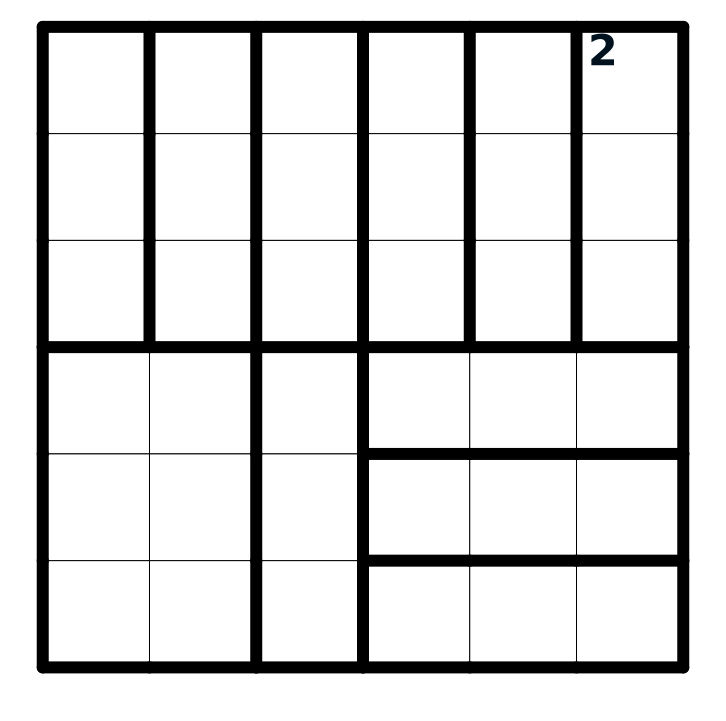
Click to see the answer.